
OUR ALBARIÑO VINEYARDS

Our vineyards: the Soul of albariño
Within the stone walls that enclose Finca Fillaboa lie nearly all of Bodegas Fillaboa’s vineyards, where the Albariño grape finds its finest expression. Each parcel is carefully tended and nurtured to preserve the authenticity of this emblematic variety, reflecting the richness of its surroundings and the singularity of its soils.

Diversity of vineyards
Fillaboa is home to 12 estates spanning nearly 50 hectares of vineyard, all devoted exclusively to the winery’s great protagonist: Albariño. From the venerable Finca Terneros, with 41 years of history, to the youthful Ribarteme, at 22, each parcel lends its own distinct character to the wines of Bodegas Fillaboa. Planted between 1985 and 2003, the vines grow in sandy loam soils, some enriched with river stone, while the Finca Río parcel rests on sediments that impart a singular minerality.

Age and soils
Each parcel carries its own history, age, and character, reflecting the richness of the soil and the orientation in which it basks in the sun.
Properties in Salvaterra de Miño
Old Estate
Albariño vineyard. Planted in 1998, 27 years old. Sandy loam soil, 40 m altitude, south-facing.
Arentey Estate
Albariño vineyard. Planted in 2000, 25 years old. Sandy loam soil with river stone, 90 m altitude, west-facing.
Carasol Estate
Albariño vineyard. Planted in 2002, 23 years old. Sandy loam soil, 95 m altitude, south-facing.
Castro Estate
Albariño vineyard. Planted in 1985, 40 years old. Sandy loam soil with river stone, 60 m altitude, south-facing.
Eucalipto Estate
Albariño vineyard. Planted in 2000, 30 years old. Sandy loam soil, 60 m altitude, south-facing.
Miño Estate
Albariño vineyard. Planted in 1999, 26 years old. Sandy loam soil with river stone, 30 m altitude, south-facing.
Monte Alto Estate
Albariño vineyard. Planted in 1987, 38 years old. Sandy loam soil with river stone, 100 m altitude, south-facing.
Río Estate
Albariño vineyard. Planted in 1986, 27 years old. Sediment soil, 30 m altitude, east-facing.
Socalcos Estate
Albariño vineyard. Planted in 1986, 40 years old. Sandy loam soil with river stone, 39 m altitude, south-facing.
Terneros Estate
Albariño vineyard. Planted in 1985, 41 years old. Sandy loam soil with river stone, 50 m altitude, south-facing.
Vía Estate
Albariño vineyard. Planted in 1985, 40 years old. Sandy loam soil with river stone, 40 m altitude, south-facing.
Las Nieves Estate
Ribarteme Estate
Albariño vineyard. Planted in 2003, 22 years old. Sandy loam soil, 100 m altitude, south-facing.
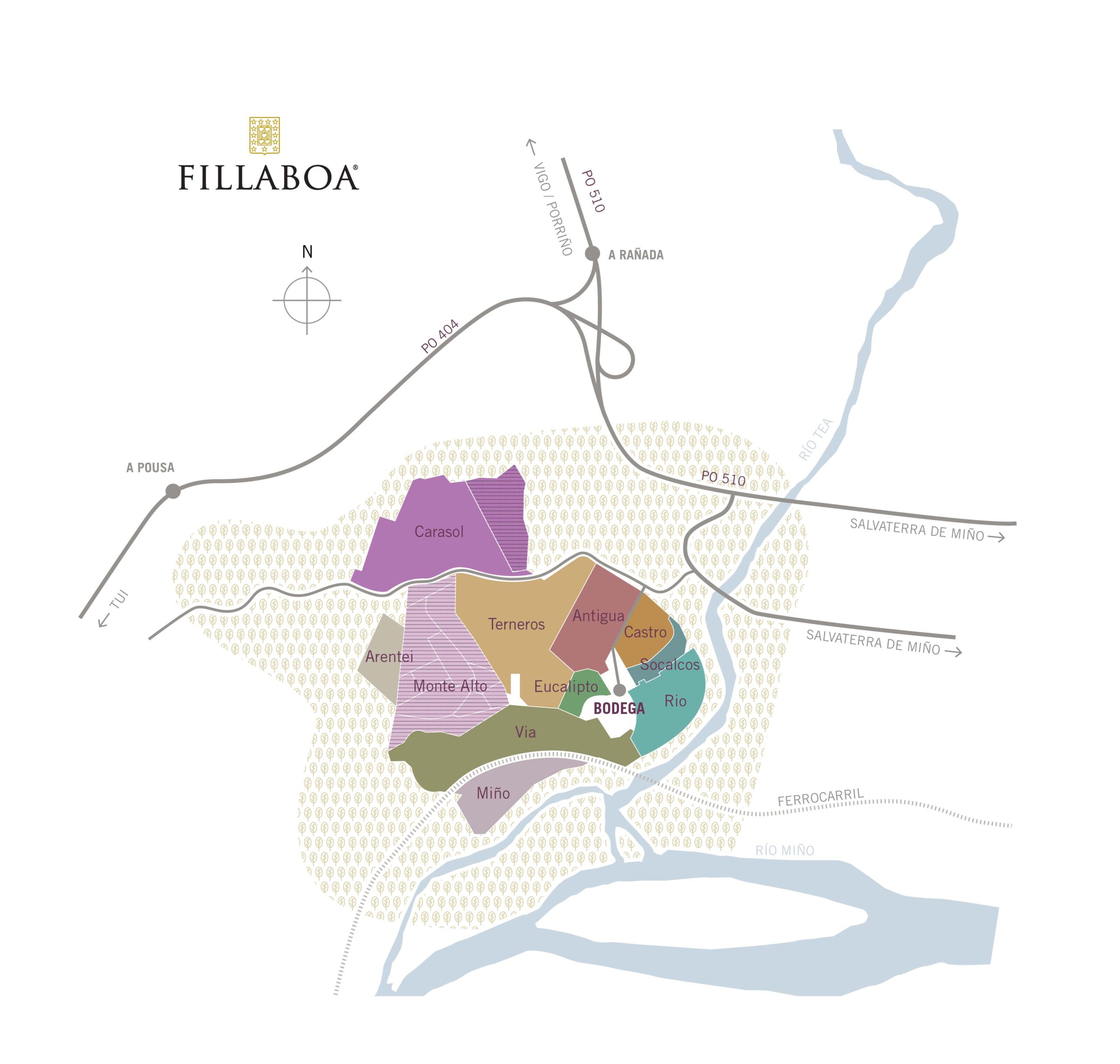
The parcels of Finca Fillaboa
Altitude and orientation
The parcels sit between 30 and 100 meters in altitude, predominantly south-facing, which ensures optimal sun exposure and balanced ripening. Finca Arentey, facing west, and the Finca Río parcel, facing east, add climatic diversity that translates into exceptional aromatic complexity.
Prime location
Most of the vineyards are located in Salvaterra de Miño, an area known for its mild Atlantic climate and river influence, ideal for growing the Albariño variety. Ribarteme, located in As Neves, complements this richness with its maximum altitude of 100 meters and south-facing orientation, lending freshness and elegance.
Tradition, sustainability and excellence
Each parcel bears witness to decades of passion and commitment, where traditional viticulture is interwoven with sustainable practices to preserve the environment and ensure the quality of every harvest. The result is the ability to craft Albariño wines that are fresh, elegant, and full of character.
Stepping into this wine-growing world means discovering the origin and history of the wines of Bodegas Fillaboa, where every vine tells a story.